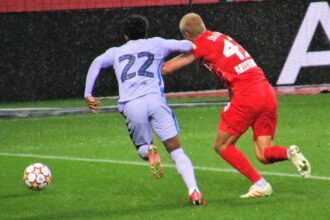
It was a Tuesday evening in November 2023 when everything stopped. Barcelona were playing Spain in a friendly international, and Gavi, twenty-two years old and at the absolute apex of his powers as one of the two or three best midfielders on the planet, received a pass on the left side of midfield, turned sharply, and fell. He did not get up for a long time. When he did, the way he walked to the stretcher told everyone who understood these things everything they needed to know.
The diagnosis, confirmed in the days that followed, was what anyone who had watched that moment feared: a complete ACL rupture, medial ligament damage, and peripheral cartilage damage to the right knee. Worst case scenario. Career-threatening, career-extending type of injury. The surgery lasted four hours. The rehabilitation was projected to take twelve to fourteen months.
He came back in April 2025, at Camp Nou, in a late-season La Liga match. He came off the bench in the sixty-ninth minute. The crowd — a generation of Barcelona fans who had watched this player develop from a sixteen-year-old curiosity into the embodiment of everything the club stood for — gave him a standing ovation that lasted for most of the remaining time he was on the pitch. Grown men in the press box, I will tell you honestly, were swallowing uncomfortable feelings.
The Injury
To understand the comeback, you need to understand the injury properly. An ACL rupture is one of the most common serious injuries in football, and the rehabilitation protocols have improved dramatically in the past decade — the average return-to-play time has fallen from eighteen months to around nine or ten, with elite medical resources. The specific complexity in Gavi’s case was the additional medial and cartilage damage, which required a more conservative rehabilitation timeline and significantly more intricate surgical reconstruction.
Barcelona’s medical staff, working alongside a specialist surgeon and the club’s sports science team, designed a rehabilitation protocol that was broken into six phases: acute recovery (weeks one to four), range of motion restoration (weeks five to twelve), strength building (weeks thirteen to twenty-four), neuromuscular retraining (weeks twenty-five to thirty-six), sport-specific conditioning (weeks thirty-seven to forty-eight), and return to full training (from week forty-nine onwards).
Gavi moved through each phase, by all accounts, with the same ferocious intensity that characterises his play. Multiple sources close to the process have described a player who arrived at every rehabilitation session earlier than required, stayed longer than instructed, and had to be repeatedly reminded that the goal was not to train maximally but to train optimally — that an injury of this severity required not just physical healing but neurological adaptation, the rewiring of automatic movement patterns that had been interrupted by the injury.
“Gavi approached his rehabilitation the same way he approaches a match. That was both his greatest asset and, at times, his greatest challenge. You cannot press your own recovery at one hundred percent.”
The Mental Challenge
In my experience covering professional athletes through serious injuries — and I have covered a number of them over three decades — the mental dimension is consistently underreported relative to the physical. The physical rehabilitation is visible, measurable, progressive. The mental challenge is none of those things. It is the anxiety that returns every time you make the movement that caused the injury. It is the automatic hesitation, the fractional pause, that can be the difference between elite and very good. It is the grief — and grief is the right word — for the version of yourself that existed before the injury.
Gavi spoke about this dimension in a candid interview with Sport in January 2025. “The knee healed before my head did,” he said. “There were weeks where physically I was ready to do things but mentally I was not. You have to wait for both. If you are only physically ready, you will get hurt again.”
The psychological support programme that Barcelona provided — sessions with a sports psychologist, group sessions with other players returning from injury, access to former athletes who had gone through similar processes — was, by multiple accounts, as important as the physical rehabilitation in getting him to the point where he could play again without reservation.
The Comeback
When Gavi came on in April against Villarreal, the context mattered. Barcelona were 2-0 up with twenty minutes to play — a comfortable situation, no pressure, no requirement to be immediately decisive. Flick gave him the opportunity to feel the grass again, to make contact with the ball in a competitive environment, to experience the crowd without the weight of a match that needed to be won.
He made fourteen touches in those twenty minutes. He completed twelve passes. He won two defensive duels. He made one driving carry that produced a dangerous Barça position. The numbers were modest. But his movement — the way he pressed with the same aggression he had always brought, the way he received the ball facing his own goal and immediately turned, the complete absence of the protective hesitation that you often see in players returning from knee injuries — told a different story.
He has played sixteen matches since that return, contributing five goals and four assists across La Liga and Copa del Rey. He is not yet the player he was in October 2023 — that player may not return until next season, when the full eighteen months of physical adaptation have been completed. But he is close enough to make the difference, and close enough to remind everyone what a fully fit Gavi looks like in this Barcelona midfield.
What It Means for Next Season
Flick has a midfield problem that most managers would be delighted to have: Pedri, Gavi, Fermín López, and Marc Casadó are all good enough to start. Only two — and sometimes three — of them can play at once. Managing their minutes, their development, and their ego in a squad environment where everyone wants to play and everyone has earned the right to play will be one of the great coaching challenges of the coming season.
The player most excited about this problem, based on everything I have heard from inside the squad, is Gavi himself. He has spent fourteen months watching his teammates play football without him. He is not interested in managing his minutes. He is interested in playing as much as possible, as quickly as possible, as intensely as possible. The medical staff will have something to say about that. The competition among the midfielders will be extraordinary to watch.
Barcelona’s midfield depth may be the most formidable in Europe next season. It took injury, rehabilitation, surgical precision, and psychological resilience to make it so. Gavi’s name is somewhere in the middle of all of those things, reminding us, as he has always done, that the truest measure of a player is not only what they do when everything is going right.